20x25x5 Air Filters: How Often If You Have Allergies?
Pull a five-inch filter out of an allergy sufferer’s furnace after four months, and you can almost read the season in it. Spring pollen stains the outer pleats yellow-green. Pet dander packs in gray and deep. We’ve opened up more of these filters than we can count, and the takeaway never changes. Your 20x25x5 is the hardest working thing in the house that nobody thinks about, and most homes leave it in months too long. If anyone under your roof has allergies, change it every three months, and check it monthly once pollen season hits. That habit is the difference between a filter that keeps allergens out of your air and one that quietly clogs and feeds them right back into the rooms where your family breathes.
TL;DR Quick Answers
20x25x5 Air Filters
A 20x25x5 air filter is a five-inch-deep media filter that slides into a whole-house cabinet on your furnace or air handler. Here’s what allergy households need to know:
What it is: a 5-inch deep media filter for a whole-house cabinet, with far more surface area than a 1-inch filter.
How often, with allergies: change it every 3 months, and check it monthly during pollen season or with pets in the house.
Best MERV: MERV 11 for daily allergen control, or MERV 13 if your system handles it and you want to catch finer particles.
Actual size: about 19.88 by 24.75 by 4.38 inches, a little smaller than the 20x25x5 name and varying by brand.
Top 5 Takeaways
Allergy and asthma homes should swap their 20x25x5 air filters every 3 months. A light-use home can stretch to 6 to 12 months, but you cannot.
MERV 11 handles pollen, dust, and pet dander. Step up to MERV 13 for finer particles when your blower can take it.
The deep 5-inch media holds far more surface area than a 1-inch filter, so it traps more and runs longer between changes.
Match the actual size, not just the 20x25x5 name, because real dimensions shift from brand to brand.
Honeywell FC100A1037, Lennox X6673, Carrier EXPXXFIL0020, and Trion Air Bear filters all fit the same slot.
How Often Allergy Sufferers Should Change A 20x25x5 Air Filter
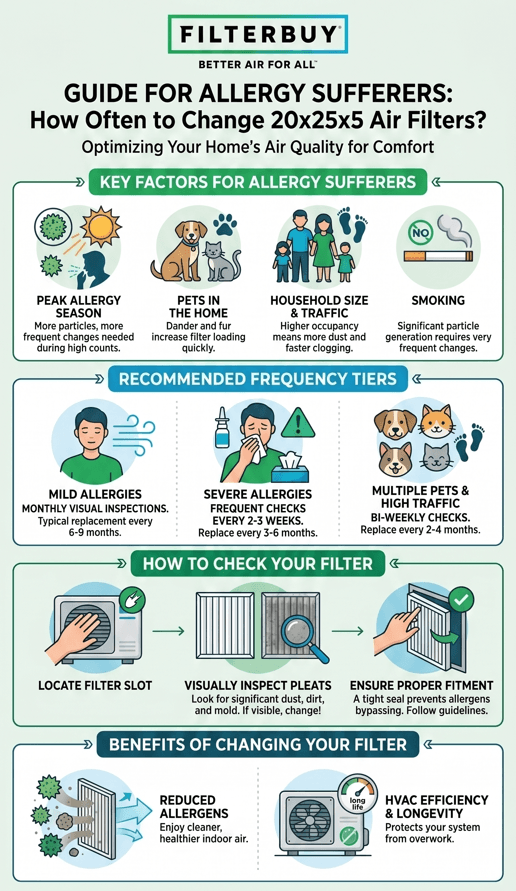
Six to twelve months. That is the run of a 20x25x5 media filter gets in an average home, and it is the number stamped on most boxes. Allergy and asthma households are not average. Pollen season, shedding pets, and windows you crack on nice days push far more particles through the system, and the media loads up well before the box’s calendar runs out. Here is the schedule we give allergy customers, drawn from what we actually see when their old filters come out:
Check it every month. Hold it up to a light, and if you cannot see through the pleats, it is done.
Replace it every 3 months as your baseline if anyone in the home has allergies or asthma.
Tighten that to 6 to 8 weeks during peak pollen or with more than one pet.
Never push a deep media filter past 6 months, even in a quiet home. A clogged filter chokes airflow and lets dirty air slip around the media instead of through it.
Leave a good filter in too long, and it stops protecting you while it strains your blower. The same logic scales down to the smaller filters elsewhere in your house, and you can see how sizing changes performance in our breakdown of 12x12x1 air filters for your HVAC system.
Choosing A MERV Rating: 20x25x5 MERV 8, MERV 11, And MERV 13 For Allergies
MERV is the score that tells you how small a particle a filter can grab. For allergies, that score matters more than the logo on the frame. Three ratings cover almost every 20x25x5 you will find:
MERV 8 catches the big stuff, lint, and larger dust. It is basic protection and light for allergies.
MERV 11 is our everyday allergy pick. It pulls most pollen, mold spores, pet dander, and dust mite debris out of the air.
MERV 13 reaches the finest particles of the three, down near one micron, including some smoke and bacteria-sized bits.
We steer allergy households toward MERV 11 or MERV 13. The deep five-inch frame is built for those higher ratings, because all that extra media area keeps air moving even as the filter works harder. One caution before you jump to MERV 13. Check that your blower is rated for it, since a tighter filter adds resistance. If you want the plain mechanics of how an air filter pulls particles out of moving air, the fundamentals are a quick read.
You will also run into MPR and FPR ratings on some shelves. Those come from specific retailers, not the MERV scale. As a rough translation, MPR 1500 sits near MERV 12, and FPR 7 sits near MERV 11. For a 20x25x5 media filter, though, MERV is the number to match.
20x25x5 Air Filter Actual Size And Why It Matters
The number on the frame is rounded. A 20x25x5 filter does not actually measure 20 by 25 by 5 inches, and it is not supposed to. Makers cut it a hair smaller so it slides into the cabinet without jamming. Across the common brands, the real footprint lands somewhere around 19.65 to 19.94 inches wide, 24.65 to 24.88 inches tall, and 4.31 to 4.38 inches deep. Always fit your cabinet to the actual size, not the rounded name. A filter that is even a quarter inch off leaves gaps, and gaps let allergen-loaded air coast right past the media. When you are not sure, measure the old filter or read the model number off its frame.
Compatible Models: Honeywell, Lennox, Carrier, And Trion Air Bear
Most major brands share the 20x25x5 opening, so one cabinet often takes several model numbers. If you are replacing an existing filter, match it by model or by actual size. The cross-references we get asked about most:
Honeywell FC100A1037 in MERV 11, and its MERV 13 sibling, the FC200E1037. Both drop into Honeywell F25, F35, F100, F150, and F200 air cleaners and the older SpaceGard 2200.
Honeywell 20x25x5 media, which people often look up by the FC100A1037 part number. Same physical filter for those cabinets.
Lennox X1152 and X6673, which fit Lennox Healthy Climate cabinets and plenty of Trion Air Bear housings.
Carrier and Bryant EXPXXFIL0020, the cross-compatible pick for those systems.
Trion Air Bear 20x25x5 media, which also takes the Lennox and Honeywell equivalents above.
The part number gets you into the right family, and the actual size confirms the fit. Choose your MERV rating around your allergies first, then grab whichever compatible model is easiest to keep stocked.
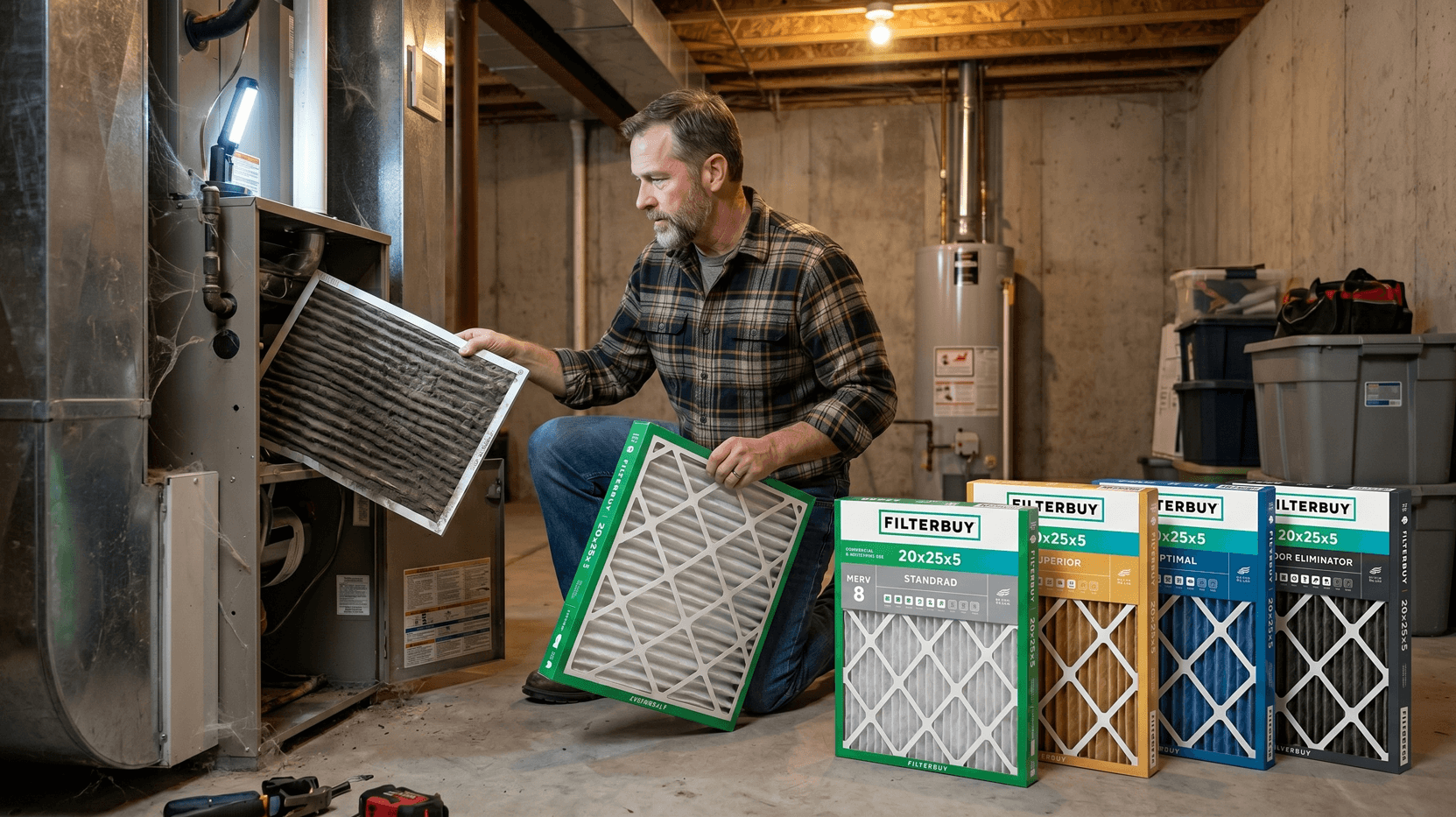
“After manufacturing filters for over a decade and serving more than two million households, we’ve found the biggest mistake allergy sufferers make is leaving a good filter in too long. A MERV 11 or MERV 13 20x25x5 only protects you while air still moves through it, so the change schedule counts as much as the rating you pick.”
Essential Resources On 20x25x5 Air Filters
Here are the sources we trust to help you choose the right 20x25x5 filter and run it well.
See How HVAC Filters Actually Clean Your Home’s Air
The American Lung Association walks through how furnace and duct filters trap pollutants, and why moving up the MERV scale catches more of what sets off allergies.
Source: American Lung Association
Learn How Filtration Eases Allergy Symptoms
Allergists explain how whole-house filtration cuts airborne pollen, dander, and mold, with steps for turning your central system into a whole-home filter.
Source: American College of Allergy, Asthma and Immunology
Get Expert Tactics For Indoor Allergens
The American Academy of Allergy, Asthma, and Immunology runs through the indoor allergen culprits room by room and shows where filtration fits in.
Source: American Academy of Allergy, Asthma & Immunology
Understand What MERV Ratings Really Mean
ASHRAE created the MERV scale, and here it clears up the myths so you can choose a rating with confidence.
Source: ASHRAE
Follow Federal Guidance On Filtration And Airflow
The CDC lays out how filtration and ventilation work together to clean indoor air, including the case for higher-efficiency filters at home.
Source: Centers for Disease Control and Prevention
Keep Your System Efficient With Clean Filters
The U.S. Department of Energy covers how routine filter changes protect both your airflow and your equipment, with simple habits to follow.
Source: U.S. Department of Energy
Allergy-Proof Your Home, Starting At The Filter
Mayo Clinic recommends a MERV 11 or higher media filter, running the fan to make a whole-house filter, and changing it every three months.
Source: Mayo Clinic
Supporting Statistics
Three numbers that explain why a clean, well-matched 20x25x5 filter earns its keep in an allergy home:
Americans spend roughly 90% of their time indoors, and indoor air can carry pollutants at 2 to 5 times outdoor levels. That is most of your day breathing the air your filter is responsible for.
Source: U.S. Environmental Protection Agency
In one home study, running air filtration cut airborne dog allergen by 89.3% and dust mite allergen by 75.2%. Those are the exact triggers a 20x25x5 media filter is built to catch.
Source: National Institutes of Health
More than 100 million people in the United States deal with allergies each year, which puts indoor allergen control on the daily to-do list for a huge share of households.
Source: Asthma and Allergy Foundation of America
Final Thoughts And Opinion
We will say plainly what years of this work have taught us. The number on the box sets you up to wait too long. Makers print 6 to 12 months because that range protects the equipment, not because it keeps your nose clear. Those are two different jobs.
For an allergy home, we treat 3 months as the ceiling, not the goal. The filters that perform best are not the fanciest ones. They are the ones people actually remember to change, which is why we tell customers to tie the swap to the start of each season.
A 20x25x5 in MERV 11 or MERV 13 is one of the best-value upgrades you can make for the air at home, as long as you treat it like a consumable instead of a fixture. Buy a few at once, keep them by the cabinet, and change them before they look dirty. Your sinuses will clock the difference long before your energy bill does.
Frequently Asked Questions
Q: How Often Should I Change A 20x25x5 Filter If I Have Pets And Allergies?
A: Every 6 to 8 weeks through shedding and pollen season, then every 3 months the rest of the year. Pets pile on dander and hair that load the media faster, so check it monthly and swap it the moment the pleats turn gray.
Q: Is The Honeywell FC100A1037 Or FC200E1037 Better For Allergies?
A: Both do the job. The FC100A1037 is MERV 11 and handles everyday allergens well. The FC200E1037 is MERV 13 and catches finer particles, so it is the strongest allergy pick when your system can support the higher rating.
Q: What Is The Actual Size Of A 20x25x5 Air Filter?
A: A little smaller than the 20x25x5 name suggests, usually around 19.88 by 24.75 by 4.38 inches, though it shifts slightly by brand. Measure your old filter or check its model number to lock in the exact fit.
Q: Will A 20x25x5 MERV 13 Filter Restrict Airflow?
A: The deep five-inch media is designed to carry a higher MERV rating while keeping air moving, which is one edge it has over a 1-inch filter. Still, confirm your blower is rated for MERV 13 before upgrading, and change the filter on schedule so it never clogs.
Q: Can A Lennox X6673 Or Carrier EXPXXFIL0020 Replace My Trion Air Bear Filter?
A: Usually, yes. These models share the 20x25x5 slot and similar cabinets, so match the actual size and the MERV rating you want, and the cross-compatible filter should slide right in.
Breathe Easier With The Right 20x25x5 Filter On The Right Schedule.
You know how often allergy sufferers should change a 20x25x5 air filter, so the rest is simple: pick your MERV rating, match the actual size, and set a three-month reminder. Stock a few 20x25x5 filters now, so a fresh one is always waiting when allergy season rolls in.
Learn more about HVAC Care from one of our HVAC solutions branches…
Filterbuy HVAC Solutions - Weston FL
2573 Mayfair Lane Weston FL 33327
(754) 296-3528
https://maps.app.goo.gl/E3tjmKf5VSWYghGc7